
Buying Guides
Vertical Blinds: The Sliding-Door Standard, Reconsidered
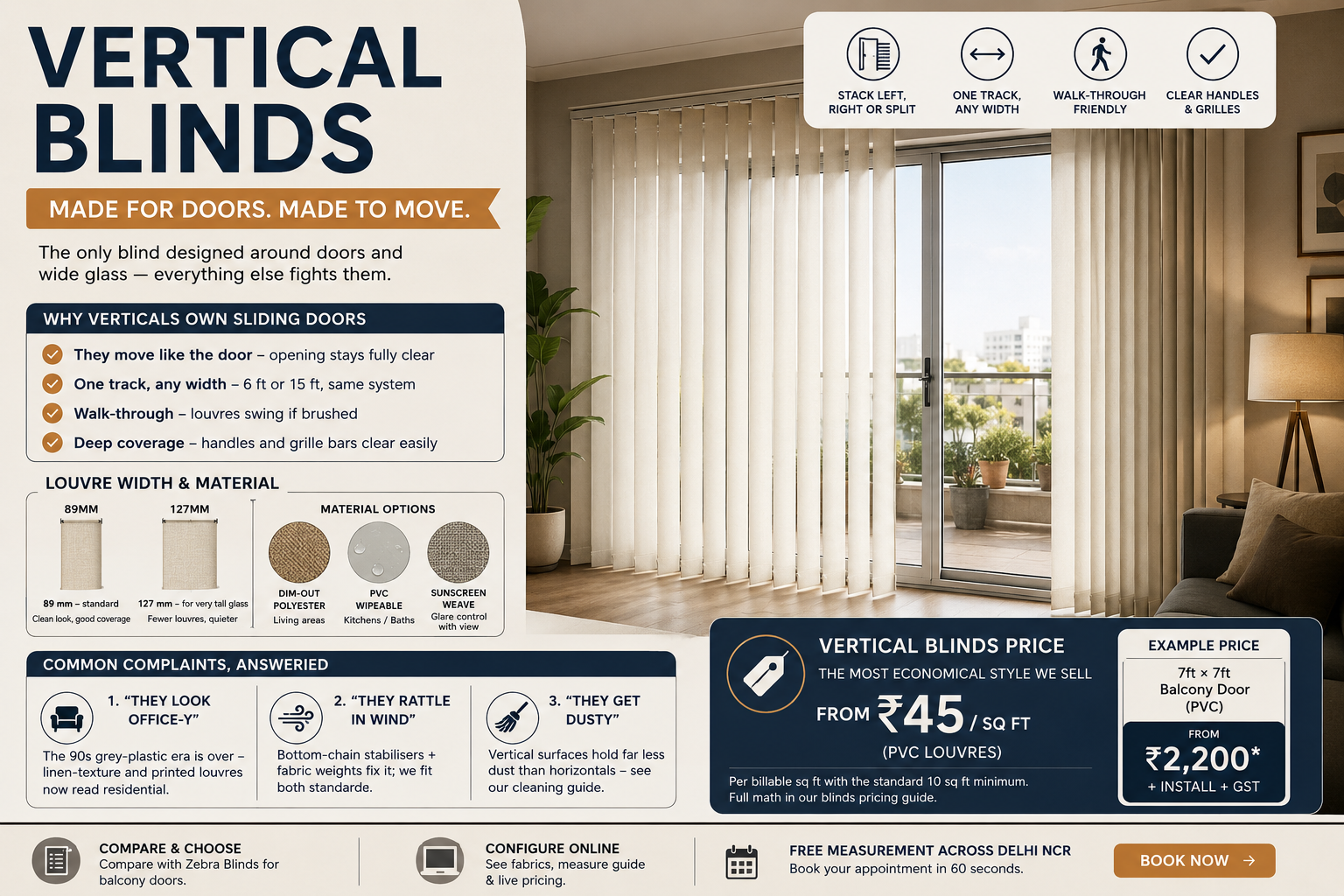
The only blind that walks with the door.
Vertical blinds hang louvres from a top track and rotate 180°, then stack to one or both sides. They are the only blind designed around doors and wide glass — everything else fights them.
Why verticals own sliding doors
- They move like the door: stack left, right or split — the opening stays fully clear
- One track, any width: 6 ft balcony door or 15 ft of living-room glass, same system
- Walk-through: louvres swing if brushed — no crumpled fabric like a roller mid-door
- Deep coverage: handles and grille bars clear easily
Louvre width and material
89 mm is the standard louvre — clean look, good coverage. 127 mm suits very tall glass (fewer louvres, quieter). Fabrics: dim-out polyesters for living areas, PVC for kitchens/bathrooms (wipeable), sunscreen weaves for glare-with-view on balconies.
Common complaints, answered
- "They look office-y": the 90s grey-plastic era is over — linen-texture and printed louvres now read residential
- "They rattle in wind": bottom-chain stabilisers + fabric weights fix it; we fit both standard
- "They get dusty": vertical surfaces hold far less dust than horizontals — see cleaning guide
Vertical blinds price
The most economical style we sell — from ₹45/sq ft (PVC louvres), fabric grades upward, per billable sq ft with the standard 10 sq ft minimum (full math in blinds pricing). A 7 ft × 7 ft balcony door in PVC starts around ₹2,200 + install + GST.
Compare with zebra blinds for balcony doors, or configure directly on the vertical blinds page — free measurement across Delhi NCR here.
Not sure of your sizes?
Read our measuring guide or try the AR self-measure tool to get exact numbers.