
Design
The Story of Light
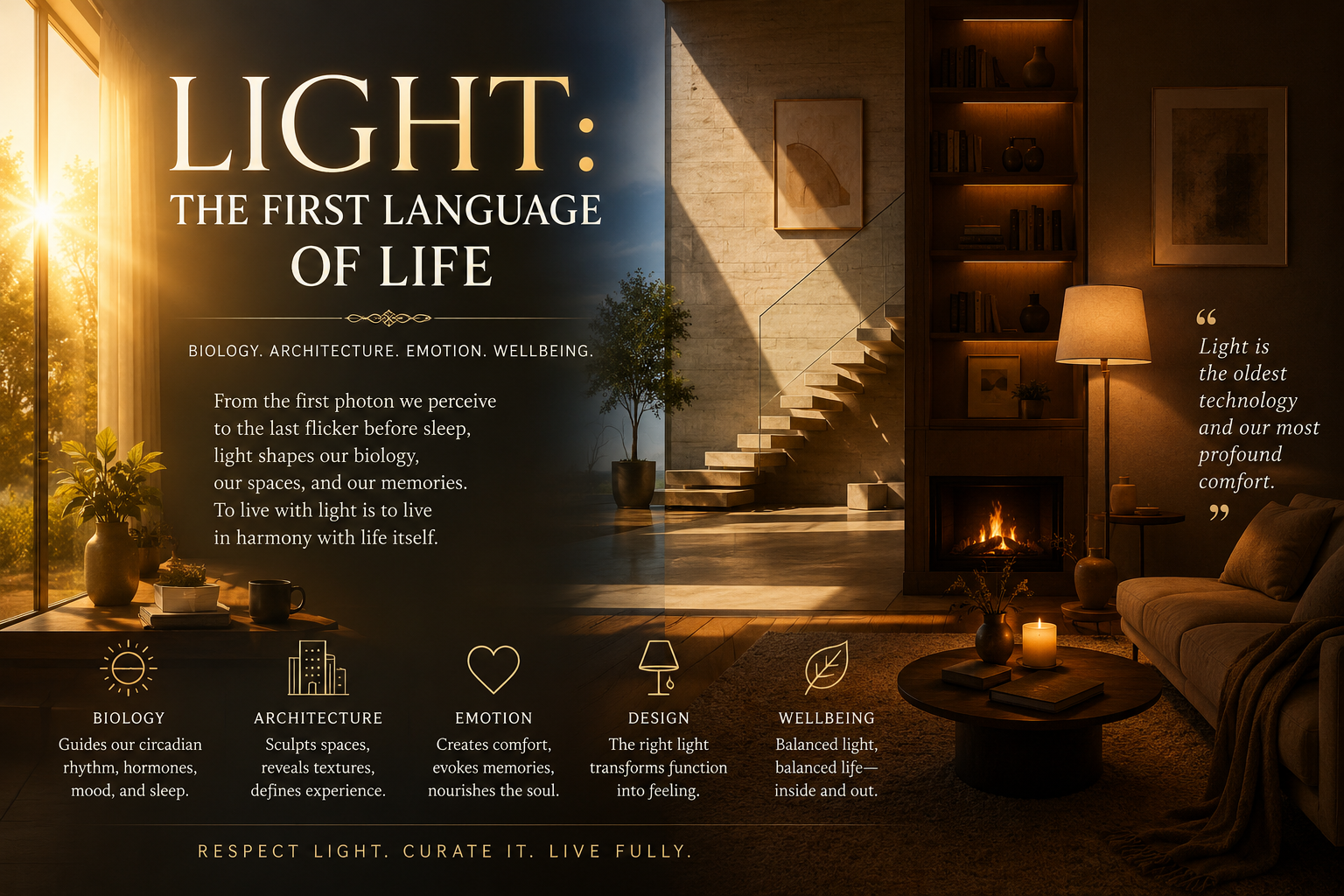
We are not just creatures of light—we are its custodians, shaping it as it shapes us.
Light: The First Language of Life
Light is the first herald of consciousness—the initial photon that collides with our nascent retinas in the womb, and the final flicker of perception we grasp before the long dark. It is the luminous thread that stitches together the tapestry of our days, framing the geometry of our mornings, sculpting the volumes of our spaces, and guiding our hesitant footsteps through the tenebrous hours of uncertainty. Yet, in the cacophonous rush of the information age, we have rendered this elemental force almost invisible through sheer familiarity. We forget its silent, profound agency—how a single, transient blade of golden sunlight can resurrect a forgotten corner of a room, or how the soft, incandescent pool of a bedside lamp can instantly transmute a mere lodging into a breathing sanctuary of the soul.
The Cosmic Lexicon and the Biology of Being
Think of light not merely as illumination, but as the oldest, most nuanced language in the cosmos. It possesses a vast and intricate vocabulary, spoken in the infinite gradients of hues, the dramatic interplay of chiaroscuro, and the fleeting poetry of reflections. Warm light, with its amber and terracotta frequencies, whispers the dialect of intimacy, comfort, and physical safety—it softens the contours of our anxieties. Cool light, steeped in cerulean and steel, hums with the sharp, electrifying energy of focus and sterile precision, honing our cognitive edges to a razor's keenness.
Dawn arrives as a shy, watercolour blush of coral and tangerine, a gentle ebbing tide that eases our synapses from the paralysis of sleep. Midday, however, is a merciless, blue-white arbiter—a high-noon clarity that sharpens our senses, drives productivity, and casts the shortest, most defined shadows. As evening exhales, the palette orchestrates a majestic descent: deep ambers bleed into burnt siennas and crimson violets, a primordial signal coded into our DNA that commands a deceleration of the heart and a preparation for rest.
This is not lyrical abstraction; it is the rigorous, unyielding language of chronobiology. Our suprachiasmatic nucleus—a master timekeeper no larger than a grain of rice, nestled deep within the hypothalamus—relies on the steady, predictable cadence of daylight to conduct the symphonic release of hormones. It orchestrates the invigorating surge of cortisol that banishes drowsiness, the serene ebb of serotonin that stabilises our mood, and the eventual, gentle flood of melatonin that guides us into the restorative depths of slumber. When we wilfully ignore this ancient, cellular dialogue—subjecting ourselves to the oppressive, flickering buzz of fluorescent tubes in windowless cubicles, or bathing our retinas in the actinic, blue-heavy glare of screens long after the sun has surrendered—we exact a grievous biological toll. We suffer the consequences in fractured sleep architecture, chronic fatigue, metabolic dysregulation, and a pervasive, indefinable melancholia that clings to our weary days.
The Invisible Material of Architecture
In the rarefied world of spatial design and architecture, light is the invisible, ethereal material that weighs nothing yet bears the immense burden of shaping every perceptual experience. It is the ultimate tool of manipulation for the human eye. A skilled architect treats natural daylight as a fluid, sculptural element; they chase the sun's trajectory across a building's facade with the precision of an astronomer, calculating solar angles to carve interior volumes with light and shadow. Great designers understand that a sliver of intense daylight grazing across a rough-hewn limestone wall reveals its tactile, mineral texture, while the soft, diffuse reflection off a polished lacquer surface creates an illusion of spatial infinity.
They employ daylighting strategies that choreograph a daily ballet: the morning sun rinses the eastern facades in a cool, cleansing wash, while the low, golden afternoon light rakes across western surfaces, elongating shadows and warming materials. In the built environment, natural light is the undisputed gold standard—it is dynamic, endlessly generous, and perpetually in flux, anchoring us to the Earth's rotation. But when the sun inevitably retreats beyond the horizon, we must step into the role of the sun itself. The choices we make in the realm of artificial lighting—the exact Kelvin temperature of the colour spectrum, the precise angulation of fixtures, the nuanced layering of ambient, task, and accent luminaires, and the subtle gradation of dimmability—dictate whether a space feels like a sterile, dissecting laboratory or a warm, enveloping womb. The difference between a clinical, interrogation-room aesthetic and a cosy, soulful haven is often merely a shift of a few hundred degrees on the colour temperature scale.
The Emotional Spectrum and the Memory of Flame
Beyond its biological and architectural functions, light carries an immense, often unspoken emotional gravitas. It is the trembling, evanescent dance of a candle flame that etches a simple dinner into the bedrock of memory; it is the soft, forgiving glow of a low-wattage bulb by the bed that invites whispered confessions and quiet vulnerability; it is the generous, welcoming radiance of a living room hearth that speaks a silent, universal invitation to "stay a while."
Conversely, it is the oppressive, pitiless glare of an overhead fluorescent that makes us feel exposed, scrutinised, and defensive, or the cold, strip lighting of a retail space that leaches the warmth from human flesh and turns a communal area into a liminal, alienating corridor. We are, at our core, phototropic beings. Ask anyone to close their eyes and vividly picture their favourite, most cherished room, and they will inevitably describe its quality of light—the way it pours through a particular window, the way it pools on a favourite reading chair, or the way it catches the dust motes dancing in the air. We are unconsciously drawn to windows, to fireplaces, to the transient magic of the golden hour—not because we consciously dissect the physics of photon scattering, but because light, in its purest essence, feels viscerally synonymous with life, safety, and continuity. The crackle of a fireplace, after all, taps into an ancestral memory stretching back to the Pleistocene, where fire represented a bulwark against the predatory darkness of the wild.
Cultivating a Curated Life of Luminosity
To live harmoniously with light is to adopt a life of intentional curation. It is the conscious, almost ceremonial act of flinging the curtains wide to greet the dawn, flooding your retina with the high lux levels required to reset your internal clock, and then, as evening descends, methodically drawing the thermal drapes to insulate yourself from the disruptive blue light of the outside world.
It requires an obsessive attention to the subtle details of your interior ecosystem: selecting bulbs with a high Colour Rendering Index (CRI) that faithfully reproduce the full spectrum of natural sunlight, flattering human skin tones, and nurturing the chromatic richness of your interiors. It means investing in sophisticated dimming systems that allow you to mimic the smooth, natural fading of twilight, rather than the jarring, abrupt binary of a simple on-off switch. It involves the careful, strategic positioning of floor lamps and sconces to cast light not just abstractly upon the walls, but specifically, warmly, upon the faces of the people gathered within them. It is a profound understanding that illumination is not merely a utility for visual acuity—it is an emotional instrument. It is the quiet, deliberate craft of creating spaces that hold us with gentle integrity, that incessantly reassure our primal nervous systems of our absolute safety, and that invite us, with undeniable grace, to inhabit the fullness of the present moment.
Epilogue: Our Oldest Comfort
In a world that often feels shrouded in metaphorical shadow and existential uncertainty, light stands as our most ancient technology and our most profound, enduring comfort. It is the language that predates human speech, the nutrient that feeds our biology, and the pigment with which we paint the canvas of our lives. To respect light is to respect the very machinery of our being; to curate it is to curate our own wellbeing. For in the end, we are not merely creatures of the earth—we are, and have always been, creatures of the light.
Not sure of your sizes?
Read our measuring guide or try the AR self-measure tool to get exact numbers.