
Buying Guides
Office Blinds: The Practical Buying Guide
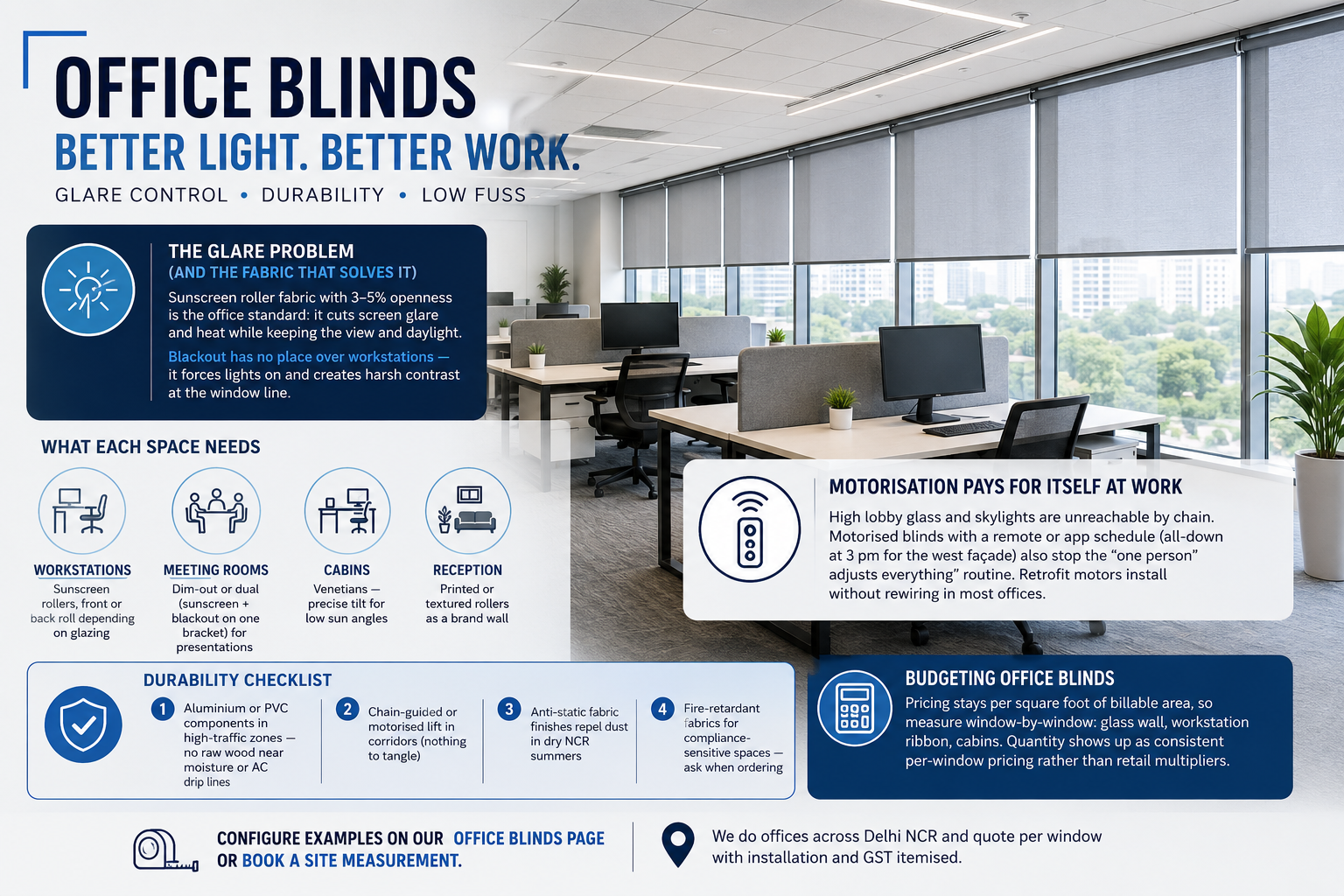
Home blinds prioritise mood; office blinds prioritise glare control, durability and low fuss. The wrong blind in an office becomes a daily irritation within a week — here is what actually works.
The glare problem (and the fabric that solves it)
Sunscreen roller fabric with 3–5% openness is the office standard: it cuts screen glare and heat while keeping the view and daylight. Blackout has no place over workstations — it forces lights on and creates harsh contrast at the window line.
What each space needs
- Workstations: sunscreen rollers, front or back roll depending on glazing
- Meeting rooms: dim-out or dual (sunscreen + blackout on one bracket) for presentations
- Cabins: venetians — precise tilt for low sun angles
- Reception: printed or textured rollers as a brand wall
Motorisation pays for itself at work
High lobby glass and skylights are unreachable by chain. Motorised blinds with a remote or app schedule (all-down at 3 pm for the west façade) also stop the "one person adjusts everything" routine. Retrofit motors install without rewiring in most offices.
Durability checklist
- Aluminium or PVC components in high-traffic zones — no raw wood near moisture or AC drip lines
- Chain-guided or motorised lift in corridors (nothing to tangle)
- Anti-static fabric finishes repel dust in dry NCR summers
- Fire-retardant fabrics for compliance-sensitive spaces — ask when ordering
Budgeting office blinds
Pricing stays per square foot of billable area, so measure window-by-window: glass wall, workstation ribbon, cabins. Quantity shows up as consistent per-window pricing rather than retail multipliers. Configure examples on the office blinds page, or book a site measurement — we do offices across Delhi NCR and quote per window with installation and GST itemised.
Not sure of your sizes?
Read our measuring guide or try the AR self-measure tool to get exact numbers.