
Explainers
How Do Blackout Blinds Work?
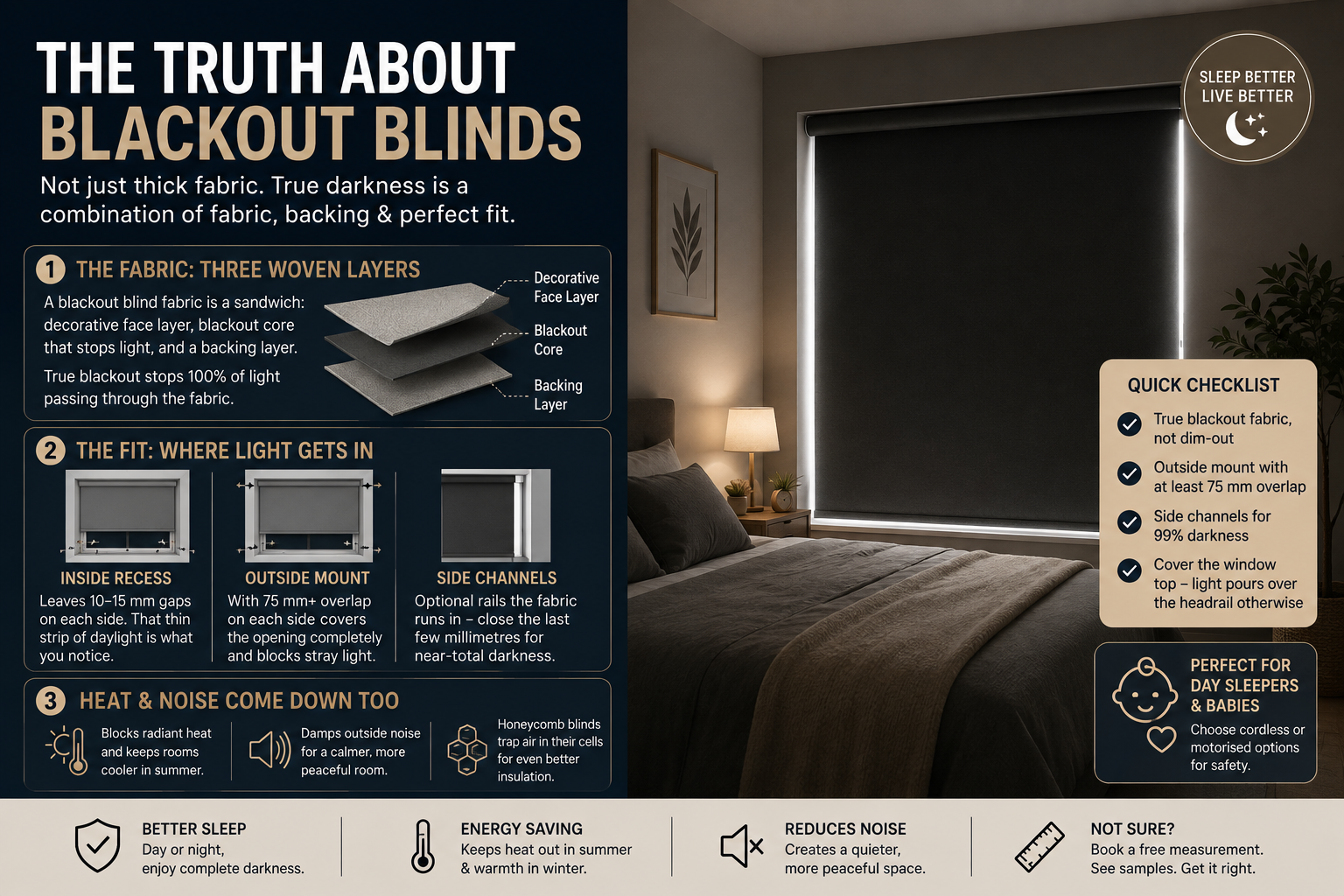
True blackout is a fabric, a backing, and a fit working together.
Blackout blinds are not just "thick curtains on a roller". They block light in three separate ways — fabric, backing, and fit. Understanding all three is the difference between a dim room and one you cannot see your hand in.
1. The fabric: three woven layers
A blackout roller blind fabric is a sandwich: a decorative face layer, a blackout core (traditionally a rubber or foam coating), and a backing. The core absorbs and stops light rather than letting it pass through the weave — which is why even pale ivory blackout fabrics keep the room dark. Dim-out fabrics block most light but leak a glow around the edges; true blackout is a different grade entirely.
2. The fit: where light actually gets in
Light does not come through a blackout fabric — it comes around it:
- Inside-recess mounts leave a 10–15 mm gap on each side for the brackets. That thin strip of daylight is what most people notice at 6 am.
- Outside mounts with overlap cover the entire opening plus 75 mm on each side — the single biggest darkness upgrade you can make.
- Side channels — optional rails the fabric runs in — close the last few millimetres for near-total darkness.
3. Heat and noise come down too
The same layers that stop light also insulate. In a Delhi May, a blackout blind on a west-facing window cuts radiant heat noticeably, and the fabric damps street noise a little. For even better insulation, honeycomb blinds trap air in their cells — many customers pair blackout rollers with honeycombs.
Do blackout blinds work for day sleepers and babies?
Yes — they are the standard answer for night-shift sleepers and nurseries. For a baby's room, choose a cordless or motorised option (no dangling cords) and an outside mount. Browse the ready-to-size range on our blackout blinds page.
Quick checklist for a properly dark room
- True blackout fabric, not dim-out
- Outside mount with at least 75 mm overlap
- Side channels if you want 99% darkness
- Cover the window top — light pours over the headrail otherwise
Not sure your windows suit an outside mount? Book a free measurement — the fitter brings fabric samples so you can see the difference before ordering.
Not sure of your sizes?
Read our measuring guide or try the AR self-measure tool to get exact numbers.