
Guides
The Best Blinds for Bedrooms (Sleep, Light & Silence)
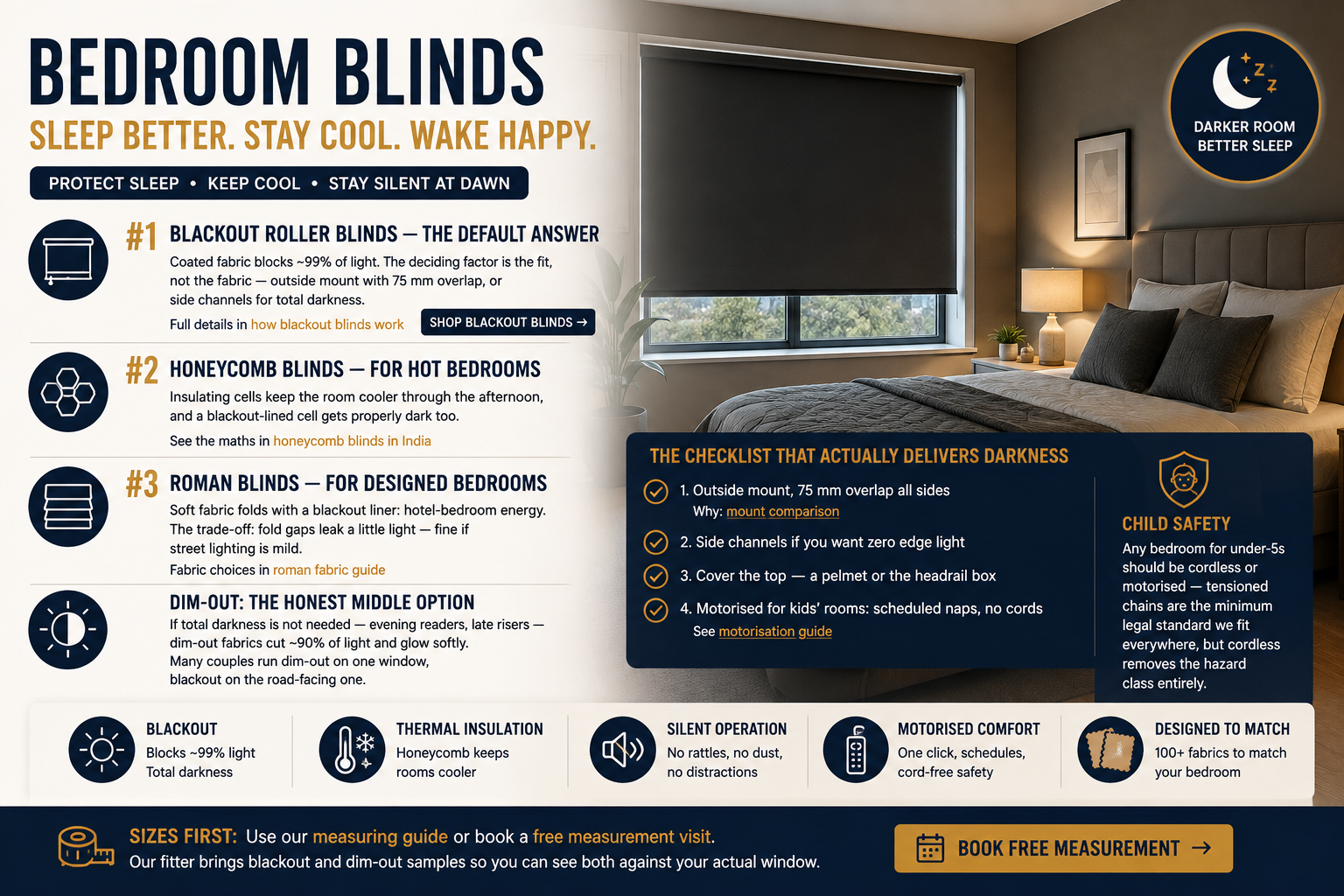
Bedroom blinds have one job: protect sleep. Everything else is negotiable.
A bedroom blind has one non-negotiable job — protect sleep — and two nice-to-haves: keep the room cool and stay silent at dawn. Here is the shortlist.
#1 Blackout roller blinds — the default answer
Coated fabric blocks ~99% of light; the deciding factor is the fit, not the fabric — outside mount with 75 mm overlap, or side channels for total darkness. The full mechanics are in how blackout blinds work. Front roll hides the tube and closes the top gap. Shop blackout blinds.
#2 Honeycomb blinds — for hot bedrooms
West-facing and top-floor bedrooms earn back the premium in AC savings: insulating cells keep the room cooler through the afternoon, and a blackout-lined cell gets properly dark too. The maths is in honeycomb blinds in India.
#3 Roman blinds — for designed bedrooms
Soft fabric folds with a blackout liner: hotel-bedroom energy. The one trade-off is fold gaps leak a little light — fine if street lighting is mild. Fabric choices in the roman fabric guide.
Dim-out: the honest middle option
If total darkness is not needed — evening readers, late risers — dim-out fabrics cut ~90% of light and glow softly instead of sealing. Many couples run dim-out on one window, blackout on the road-facing one.
The checklist that actually delivers darkness
- Outside mount, 75 mm overlap all sides (why: mount comparison)
- Side channels if you want zero edge light
- Cover the top — a pelmet or the headrail box
- Motorised for kids' rooms: scheduled naps, no cords — see motorisation guide
Child safety
Any bedroom for under-5s should be cordless or motorised — tensioned chains are the minimum legal standard we fit everywhere, but cordless removes the hazard class entirely.
Sizes first: the measuring guide or a free measurement visit — the fitter brings blackout and dim-out samples so you can see both against your actual window.
Not sure of your sizes?
Read our measuring guide or try the AR self-measure tool to get exact numbers.